
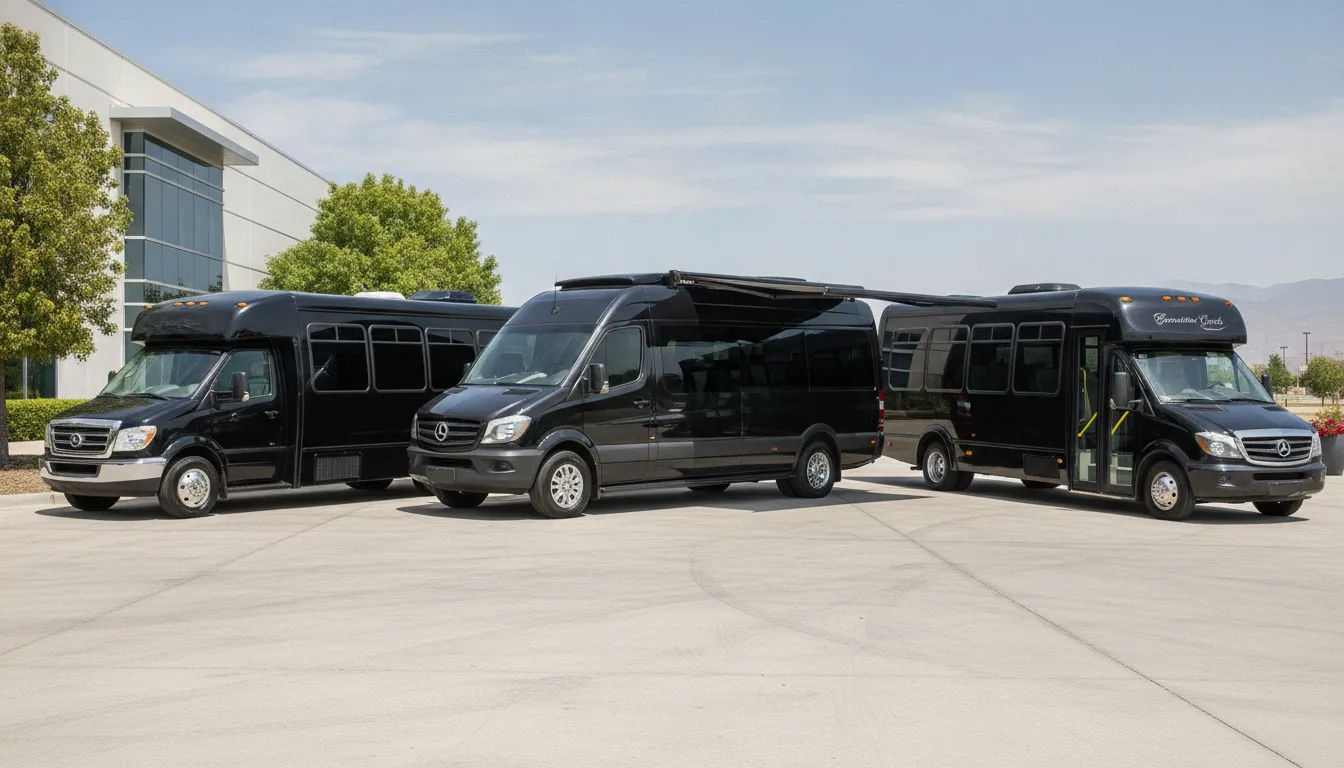
Choosing among charter bus services starts with a practical question: which vehicle can carry every passenger and every bag comfortably while fitting the route? For travel in Philadelphia and the surrounding 60-mile area, the answer may be a 14-passenger shuttle van, an executive-style Sprinter, a mini coach, or a full-size motor coach. The right choice protects the schedule, simplifies communication, and gives guests a more consistent experience from pickup to final drop-off.
Plan your event transportation and request a custom quote.
Charter bus services: quick vehicle comparison
Quick answer: Choose a shuttle van for up to 14 passengers with about 12 luggage pieces, a Sprinter van rental in Philadelphia for a smaller group seeking executive comfort, a mini coach for a mid-sized group, or a motor coach for the largest groups and longer regional routes.
Vehicle selection is not simply about reserving the smallest option with enough seats. Passenger count, luggage volume, route access, boarding time, trip duration, and desired amenities all affect the decision. A group with 12 travelers and 12 full-size bags may need a different configuration than a group with the same head count carrying only briefcases.
The comparison should also account for how the group will use the vehicle during the day. A direct transfer has different demands than a schedule with several pickups, waiting periods, and return trips. For a multi-stop program, planners should consider how quickly passengers can board, whether the driver has an approved place to wait, and how schedule changes will be communicated. These operational details can be as important as seat count.
Smaller vehicles are often easier to position at hotels, offices, and busy curbside pickup points. Larger coaches keep more people together and offer greater luggage capacity. A professional transportation coordinator can review the complete itinerary and recommend a vehicle that balances space, comfort, access, and cost.
| Vehicle Type | Seating | Room for Bags | Best Use Case |
|---|---|---|---|
| Shuttle Van | 14 Guests | 12 Bags | Airport transfers |
| Sprinter Van | 12 Guests | 10 Bags | Executive travel |
| Mini Coach | 44 Guests | 50 Bags | Corporate events |
| Motor Coach | 56 Guests | 60 Bags | Long-distance trips |
These figures are useful planning benchmarks, but the final fit depends on the specific vehicle configuration and the size of the luggage. Share exact requirements before booking rather than assuming every seat and storage space can be used at the same time.
Start with passenger count, luggage, and route
Planning rule: Confirm the final head count, count large and unusual luggage separately, list every stop, and note any access needs before requesting a vehicle recommendation.
Count people and bags separately
A reliable plan begins with a named passenger list, not an estimate. Leave enough capacity for late additions when attendance is not final. Then create a separate luggage count. The 14-passenger shuttle van, for example, accommodates about 12 luggage pieces. If all 14 passengers bring large suitcases, a larger vehicle or a different luggage plan may be necessary.
Ask about equipment that does not fit a normal bag count, such as presentation materials, display cases, mobility devices, or oversized personal items. Tell the transportation team about these items in advance so they can account for usable storage and safe boarding.
Map each pickup, stop, and deadline
Provide complete addresses, requested pickup times, appointment or flight times, and the preferred arrival buffer. Note whether guests will board together or at multiple locations. Several hotel pickups may make a smaller, nimble vehicle attractive, while one central departure can favor a larger coach.
Route access also matters. Loading zones, narrow streets, property entrances, and venue rules can limit where a larger coach can safely stop. Planning these details early reduces day-of improvisation and helps the driver follow a realistic schedule.
Identify comfort and accessibility needs
Trip length influences what guests value. For a short transfer, efficient boarding and convenient curb access may matter most. For a longer ride within the service area, passengers may appreciate additional legroom and coach-style amenities. Discuss accessibility needs during planning so the provider can confirm an appropriate vehicle and boarding arrangement.
When a 14-passenger shuttle van fits best
Best fit: A shuttle van is practical for a small group with light to moderate luggage, short local transfers, and itineraries that benefit from quick boarding or easier curb access.
Efficient airport and hotel transfers
A shuttle van can keep a small party together without requiring the footprint of a coach. The 14-passenger model has room for about 12 luggage pieces, making the baggage count especially important for an airport transportation plan for larger groups. If travelers carry more than one large bag each, ask whether another vehicle will provide a better fit.
For hotel-to-office transfers and short meeting schedules, shuttle vans can make boarding straightforward. Their size may also help at pickup points where a full-size coach would be difficult to position. One coordinated vehicle keeps the group on a shared schedule and avoids the communication problems that often come with multiple rides.
Where a shuttle van reaches its limits
A shuttle van is not automatically the best value just because the group fits the seat count. A completely full cabin, substantial luggage, a longer route, or requests for more executive-style surroundings may point toward a Sprinter, mini coach, or motor coach. Comfort and storage should never be treated as afterthoughts.
When comparing charter bus services, explain the actual use case rather than asking only for a 14-passenger vehicle. A helpful coordinator will consider the people, bags, route, timing, and pickup conditions together.
Why groups choose a Sprinter van
Quick answer: A Sprinter van rental in Philadelphia suits a smaller group that wants easier city access and a more polished, executive-style travel environment. Available passenger and luggage configurations should be confirmed for the specific trip.
Executive comfort in a smaller footprint
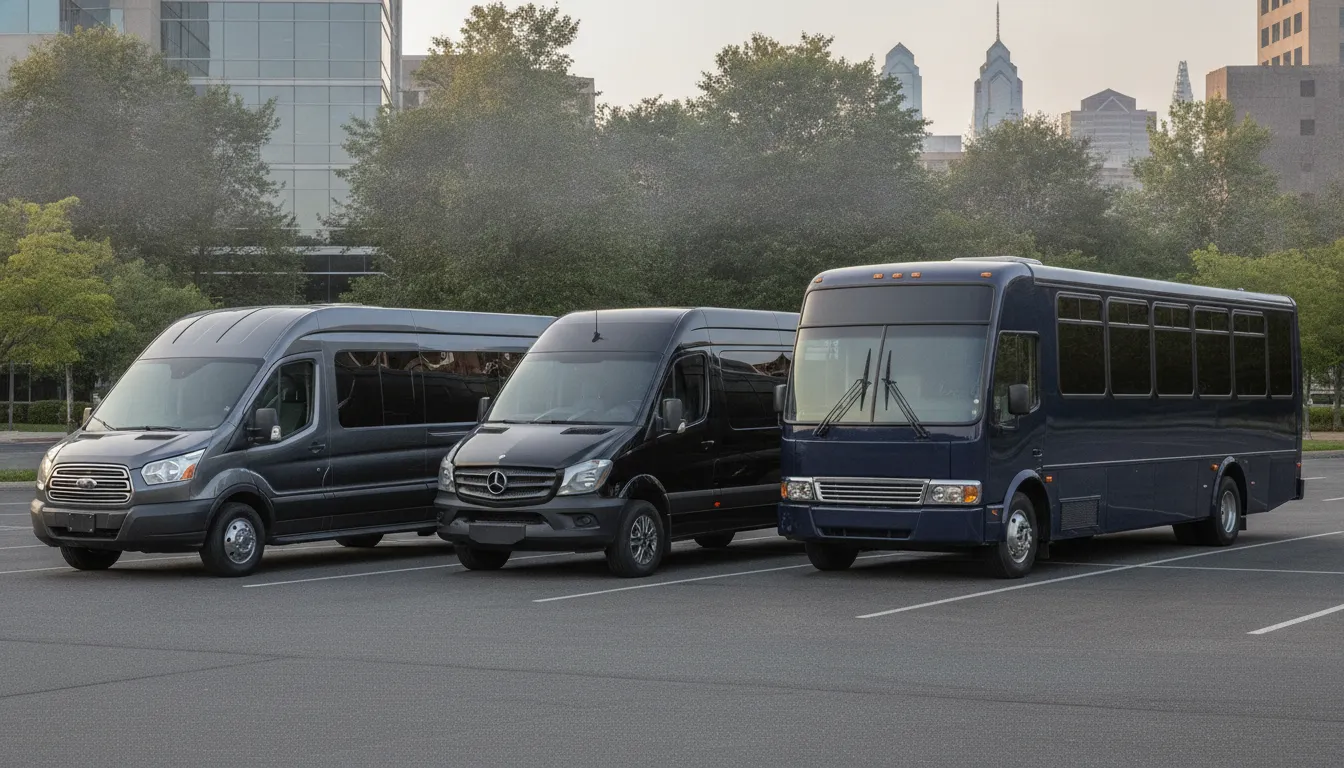
Sprinter vans occupy a useful middle ground between a standard shuttle van and a coach. A common configuration accommodates up to 12 passengers, while some trip needs are better matched to a 10-passenger arrangement. The correct choice depends on the available vehicle, desired cabin space, and the amount of luggage. Confirm both capacities before booking.
For business travelers, a Sprinter offers a professional arrival without separating the party across several cars. Its smaller footprint can help with hotel entrances, office stops, and other Philadelphia-area pickup points where a large vehicle is less convenient. Faster group boarding can also support an itinerary with several scheduled stops.
Match the configuration to the luggage
Do not assume that every Sprinter configuration holds the same number of passengers and bags. Seating layouts and storage space vary. A team carrying briefcases may fit comfortably in a setup that would not suit the same number of airport travelers with full-size suitcases. Give the provider a realistic luggage count and ask for confirmation in writing.
A Sprinter is often attractive when presentation and efficient access matter as much as capacity. For a group that mainly needs maximum seating or extensive storage, a mini coach may make more sense.
When a mini coach or motor coach makes sense
Capacity guide: A mini coach is a strong option for mid-sized groups that need more seating and storage, while a motor coach is suited to the largest groups and routes where coach amenities add value.
Mini coaches for mid-sized groups
A mini coach bridges the gap between vans and full-size coaches. It can keep a mid-sized party in one vehicle while providing more room for luggage and a coach-style experience. The comparison table uses a 44-passenger, 50-bag mini coach as a planning reference. Exact capacities should still be confirmed against the assigned vehicle.
This category works well for Reliable & Professional Transportation for Meetings, Events & Conferences. It can move attendees between hotels, meeting venues, offices, and dining locations while keeping communications centralized. Explore Ace Limousine’s event transportation service when coordinating a schedule with multiple arrivals, departures, or venue movements.
For conferences with guests arriving at different times, a mini coach may operate in planned loops rather than making one departure. A loop schedule requires clear pickup windows, visible meeting points, and enough turnaround time for traffic and boarding. Organizers should assign an onsite contact who can confirm when each wave is ready. This approach helps keep the main program moving while giving attendees a predictable transportation plan.
Motor coaches for the largest groups
A full-size motor coach is designed to move the most passengers together. The 56-passenger, 60-bag coach shown in the table is a practical reference for large manifests. Motor coaches may also include a restroom, which can improve comfort and reduce unscheduled stops on longer regional rides.
The benefit of a larger vehicle must be weighed against route access and loading logistics. A coach needs adequate curb space, suitable entrances, and enough time for a larger group to board. Confirm these details with venues and the transportation coordinator before finalizing the itinerary.
One larger coach or several smaller vehicles?
One coach simplifies head counts, instructions, and arrival timing. Several smaller vehicles can provide flexibility for separate pickup points or staggered schedules. The best structure depends on whether the group’s priority is staying together or moving in smaller waves. Ace Limousine’s Philadelphia group transportation team can help evaluate both approaches.
Build a dependable Philadelphia-area itinerary
Itinerary essentials: Share all addresses, pickup windows, passenger contacts, flight or meeting deadlines, luggage counts, and venue loading instructions in one final schedule.
Plan backward from the real deadline
A pickup time should reflect more than drive time. Build in time for boarding, traffic, security procedures, and walking from the drop-off point. For airport service, work backward from the airline’s recommended arrival time. For meetings and conferences, use the time attendees must be seated, not merely the published start time.
Philadelphia traffic and curb conditions can change throughout the day. A schedule that looks reasonable on a map may not account for loading a full group or reaching a designated entrance. A local provider can help identify realistic timing within Philadelphia and the surrounding 60-mile area.
Create one source of truth
Maintain a final itinerary that lists each stop in order, the onsite contact, passenger count, luggage notes, and required arrival time. Distribute the same version to planners and key contacts. Last-minute revisions should go through one designated coordinator so conflicting instructions do not reach the driver.
For a complex company itinerary, review the steps for how to arrange transportation for a company event. A clear plan makes it easier to price the service accurately, select vehicles, and identify schedule risks before travel day.
The itinerary should also distinguish firm commitments from estimates. Flight numbers, meeting start times, and venue access windows are firm details. Approximate boarding duration or the timing of a flexible stop may remain an estimate until the passenger list is final. Labeling both types helps the coordinator focus attention on the constraints that cannot move. Before travel day, issue a final version with a timestamp so every stakeholder knows which schedule is current.
Use a final confirmation checklist
- Confirm the passenger total and primary group contact.
- Confirm the number and approximate size of luggage pieces.
- Verify every address, entrance, and loading instruction.
- Review pickup times and required arrival times.
- Confirm the selected vehicle’s seating and storage capacity.
- Share accessibility requirements and special equipment needs.
- Establish how updates will be communicated on travel day.
- Share the complete itinerary and passenger count.
- Confirm luggage, access, and comfort requirements.
- Review the recommended vehicle and final quote.
Frequently asked questions about charter bus services
How do I choose between a shuttle van, Sprinter, and mini coach?
Start with confirmed passenger and luggage counts, then consider route access, trip length, desired comfort, and pickup conditions. A shuttle van suits many groups of up to 14 with about 12 bags, a Sprinter offers executive-style travel for a smaller group, and a mini coach provides more seating and storage for a mid-sized group.
How far in advance should I request a quote?
Request a quote as soon as the date, approximate group size, and itinerary are known. Earlier planning provides more time to confirm the right vehicle and refine logistics. Availability varies, so time-sensitive or multi-vehicle trips benefit from an early request.
What information is needed for an accurate quote?
Provide the travel date, all pickup and drop-off addresses, schedule, passenger count, luggage count, accessibility needs, requested vehicle type, and onsite contact details. Mention multiple stops, flight information, and any venue loading restrictions.
Can charter bus services handle large group airport transfers?
Yes. A transportation plan can use one larger coach or several coordinated vehicles based on arrival times, passenger totals, luggage, and terminal logistics. Accurate flight and baggage details help the provider recommend the right structure.
Request the right vehicle for your group
The best vehicle is the one that supports the complete itinerary without forcing compromises on seating, storage, access, or timing. Gather the details first, then let an experienced transportation team compare the practical options. Ace Limousine & Airport Service can help plan charter bus services for Philadelphia and the surrounding 60-mile area, from small airport transfers to coordinated transportation for meetings, events, and conferences.
When requesting a recommendation, share what is known and identify what may still change. A preliminary passenger estimate is enough to begin the conversation, but the final selection should follow a confirmed count and luggage review. Ask the coordinator to explain why the recommended vehicle fits, what capacity assumptions were used, and when final details are due. That short review helps planners understand the proposal, compare options fairly, and avoid preventable changes close to travel day.